Palate Expander Before and After What actually changes, & why it matters beyond the arch.
Most people searching "palate expander before and after" want proof that expansion works. The structural truth is more useful: visible arch widening is only the surface. What changes underneath, in tongue space and nasal airway volume, is the result that actually matters.
The narrow jaw problem most dentists do not mention.
Before any "after" makes sense, the "before" needs to be honest. A narrow upper arch is not a cosmetic detail. It reduces tongue space, elevates tongue posture, and restricts nasal airflow above. Patients with the cluster (crowded teeth, mouth breathing, snoring, broken sleep, jaw clicking) often have one upstream cause.
Photographs of arches before and after expansion are useful only if you understand what changed and why. The visible widening is a marker, not the work itself.
What a palate expander actually does to your jaw.
A palate expander applies slow, controlled lateral force at the mid-palatal suture. In children and adolescents this widens the bony arch as new bone fills the suture gap. In adults whose suture has fused, bone-anchored devices (MARPE) apply force directly to the palatal bone via small titanium miniscrews.
This is sutural remodelling: the bone responds to load, the suture opens, new bone forms. It is not tooth movement, and the visible "after" photo shows skeletal change, not cosmetic positioning.
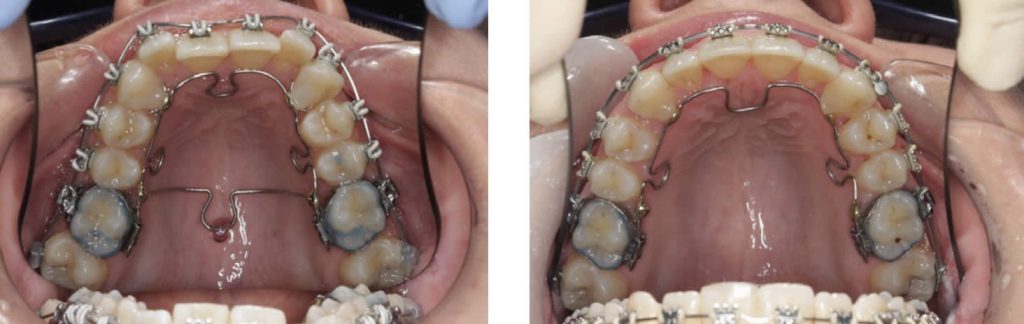
Before and after: what changes in the arch.
Visible changes in arch width are usually the first thing patients and clinicians notice. The arch broadens. The teeth space out, sometimes opening a temporary diastema between the upper front teeth that closes as the surrounding teeth and bone settle. The palatal vault, which is often high and narrow before expansion, becomes lower and wider.
These changes are structural, not cosmetic. They are achieved by bone remodelling rather than by repositioning teeth that were already where they were. That is why expansion results, when planned and retained correctly, tend to be more stable than orthodontic crowding fixes alone.
We measure the changes, not just photograph them. Inter-molar width (the distance between the upper first molars at the gum line) is the most commonly reported number, and gains of four to nine millimetres are typical in successful adult MARPE cases, with larger gains in growing children. Inter-canine width, palatal vault height, and arch perimeter all change measurably alongside it. The photograph is just the visible part of a numerical change we can verify on imaging.
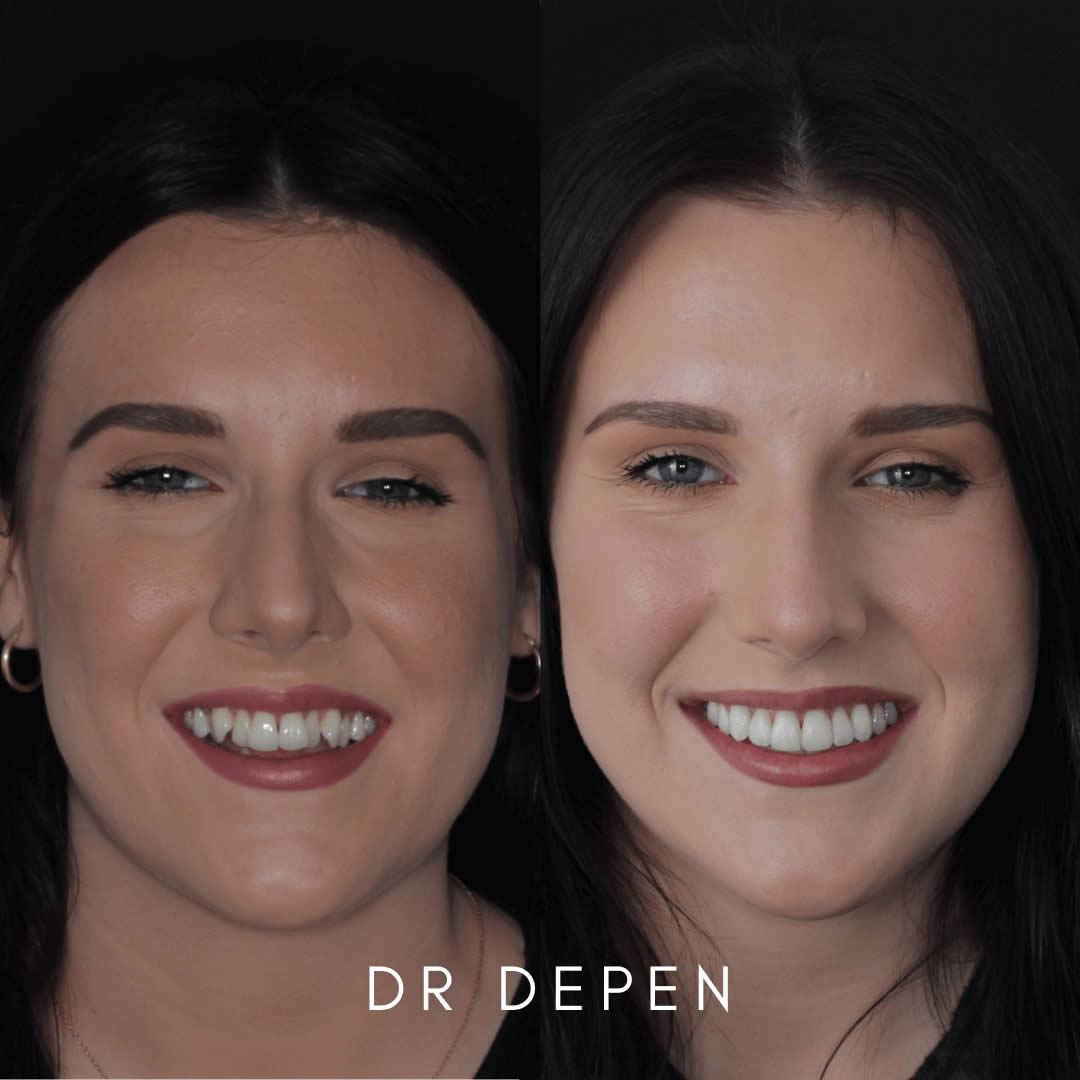
Before and after: what changes in the airway.
This is the part most before-and-after content does not cover. The palate is the floor of the nasal cavity. When the arch widens, the floor of the nose widens with it. Nasal cavity volume can increase. Tongue space increases as the arch broadens. The tongue is more likely to rest against the palate rather than fall back toward the airway.
Many patients report changes in snoring, mouth breathing, and sleep quality after expansion. These outcomes are not guaranteed and not measured by a smile photograph. They are the reason the work has clinical value beyond aesthetics.
What we actually measure on the CBCT scan.
Before-and-after photographs of the arch are powerful because they are visible. The more meaningful changes happen above the palate, in the nasal cavity and the pharyngeal airway, and those are not visible to the camera. The CBCT scan is what captures them.
We measure nasal cavity volume at three reference points, the minimum cross-sectional area of the airway from the soft palate downward, palatal vault height, and the width of the bony floor of the nose. After successful expansion, nasal cavity volume often increases meaningfully, and many patients report that nasal breathing feels easier within weeks. We do not promise this; we measure it.
Numbers do not replace symptoms, but they keep the conversation honest. A patient who reports better sleep with measurable airway gains has more confidence in the result than one whose evidence is only how things look.
What does not change, and why we say it plainly.
A palate expander does not whiten teeth, close gaps that existed before treatment (other than the temporary suture diastema, which closes on its own), or guarantee resolution of sleep apnoea. It does not "snap your face into shape". It does not replace orthodontic alignment in cases that need it; expansion is often the first step in a sequence that may include aligners or fixed appliances afterwards.
It also does not undo the consequences of previous extraction-based treatment in the way patients sometimes hope. Teeth that were removed twenty years ago are gone. What expansion can do is restore the room those teeth used to occupy, which sometimes allows for prosthetic replacement that fits properly. The lower-face changes after that are usually subtle, occasionally remarkable, and never guaranteed.
We say all this on the first visit, not after the treatment is paid for. The work is honest mechanism, not a transformation product.
Adults versus children: the results are different, and here is why.
Children's sutures are unfused, which means expansion is faster and more predictable. The arch widens, the dental crowding eases, and the changes integrate into ongoing facial growth.
In adults, the suture is partially or fully fused. MARPE or surgically assisted expansion is often needed to achieve real skeletal change. Adult outcomes can still be substantial, but they tend to be subtler and the timeline is longer. The honest version of an adult before-and-after is structural, not dramatic.
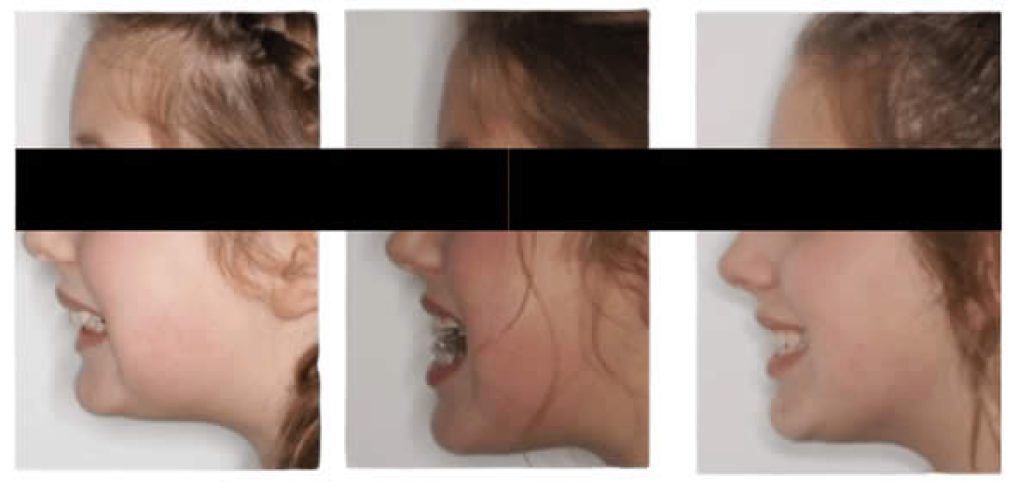
What the outdated approach looks like.
Extraction and retraction. Remove premolars to relieve crowding, retract the front teeth into the gap. The before-and-after is straight front teeth in a narrower arch.
The structural cost is rarely shown in the photo. The arch is smaller, the tongue has less room, the soft palate has less space to sit forward of the airway. Patients who present in their thirties with broken sleep and a narrow palate often had this exact treatment as teenagers. We mention it because it explains a lot of adult cases.
The WideSmiles™ approach at Dr Depen's clinic.
WideSmiles™ is the slow-expansion method we use. It works with biology rather than against it: minimal forces, controlled rate, retention built into the plan from the start. Within the broader Jawthodontics™ framework, expansion is one tool among several (including myofunctional therapy and tongue tie release where indicated).
The protocol is personalised to your jaw anatomy, airway and age. It is not a pre-set timeline or a single device. The honest version of what your "after" will look like depends on what your "before" actually is.
What to expect from a structural jaw assessment.
CBCT imaging to map the suture and airway. Tongue posture and breathing pattern review. Jaw joint examination. A clinical history and a written plan. Sixty minutes. £350. Fully redeemable against treatment.
The assessment is the bridge between curiosity about before-and-after photos and an honest answer about what your specific case might achieve.
Common questions about palate expander results.
Does it hurt? Pressure rather than pain, mostly. How long does it take? Months of active expansion plus a retention phase. Will the results last? With proper retention and (where indicated) myofunctional support, often yes. Will it change my face? Subtle changes in lower-face support are possible, particularly in younger patients. None of these answers is a marketing promise.
The cases that surprise us.
After years of doing this, the cases that still surprise us are the ones where the symptom relief outruns what the imaging predicted. A patient with modest measurable airway gain reporting their first full night of sleep in a decade. An adult who came in for crowding mentioning, six months later, that they have stopped clenching at night without trying to.
We do not use these as marketing claims. They are not predictable, and we cannot tell you in advance whether you will be one of those cases. We mention them because the structural argument for expansion sometimes underestimates the downstream effects, and over-promising would do the same in the opposite direction. The honest version sits between the two.
What patients tell us in the first year after treatment.
Patterns emerge in the way patients describe their own results, and they do not always match what we measure. The first thing most adult patients mention at the six-month review is not the arch or the teeth. It is sleep. Variations on "I have not had to think about how I am breathing at night" come up often. This is anecdotal, not a clinical claim, but it is consistent enough to mention.
Around the same point, partners often comment on snoring before the patient does. The pattern at six months is usually: the patient has stopped noticing something they used to notice, and someone else has noticed the absence. By twelve months, jaw clicking and clenching that the patient may have lived with for years often becomes background or disappears, although we will not promise either.
The visible arch and dental changes plateau earlier, within months. The downstream changes (sleep, breathing pattern, jaw joint comfort) often continue to evolve through the first year. We mention this because patients sometimes look at the six-week photo and wonder if that is the result. It usually is not. The structural result is what holds; the functional changes catch up.
Frequently asked
Do palate expanders work for adults?
Adult expansion can be effective, but the approach often differs from childhood treatment. Because the mid-palatal suture is typically fused in adults, skeletal anchorage methods such as MARPE may be used to achieve structural change. Results vary depending on age, anatomy and the specific method used.
How long does it take to see results from a palate expander?
Visible arch changes may begin within a few months of treatment, though the full remodelling process often takes longer. The timeline depends on the type of expander, the patient's age and how much expansion is needed in their specific case.
Does a palate expander change your face?
Expansion can influence facial width and the appearance of the midface in some cases, particularly when treatment begins during growth. In adults, changes tend to be more subtle. Any facial changes are a structural outcome, not a cosmetic goal.
Is palate expansion available on the NHS?
NHS orthodontic treatment in the UK is generally limited to patients under 18 and focuses on dental alignment rather than airway or structural outcomes. Adult palate expansion is almost always provided privately.
Will the results of palate expansion last?
Expansion results can be stable long-term when the treatment is followed by an appropriate retention phase and, where relevant, myofunctional support. Without retention, some relapse may occur. Retention should be part of the overall plan.
Can a narrow palate affect breathing and sleep?
A narrow palate may reduce tongue space and nasal airway volume, which can contribute to mouth breathing, snoring and disrupted sleep in some people. Expansion does not guarantee resolution of these symptoms, but addressing the structural cause is often a useful starting point.
What is the difference between a removable expander and MARPE?
A removable expander is typically used in children whose sutures are still open and can be widened with lighter forces. MARPE uses small titanium screws anchored in the palatal bone to apply force directly to the skeleton, making it more suitable for older teenagers and adults whose sutures are partially or fully fused.