MARPE in the UK What it is, who it is for, & where to get it as an adult.
Most people searching "MARPE UK" have already done the homework. They know the acronym, they suspect they need it, and they cannot find a London clinic that actually offers it for adults. This is the page that answers that search seriously.
Why adults with narrow palates end up searching for MARPE specifically.
The arrival pattern is consistent. A history of broken sleep or unexplained fatigue, a sleep study that hinted at upper airway resistance, perhaps an ENT referral that resolved less than it promised. Somewhere along the way a clinician used the word "MARPE" or a forum thread named it. Now you are reading.
The structural problem is upstream of the device. A narrow maxilla means a high palatal vault, which means reduced tongue space, which often means a compromised nasal airway. MARPE is one of the tools that can change that in adults. It is not magic and it is not for everyone. It is mechanism, and mechanism deserves an honest explanation.
What MARPE actually does, and why the mechanism matters for adults.
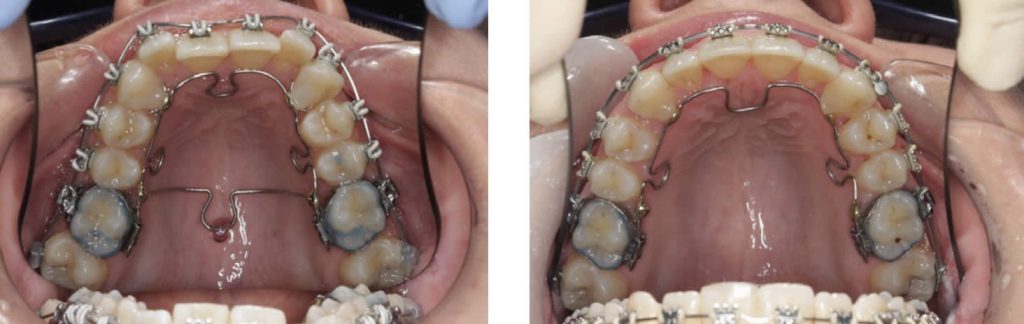
MARPE (Mini-implant Assisted Rapid Palatal Expansion) is a bone-anchored appliance. Four small titanium micro-implants are placed through the soft tissue into the palatal bone itself, and the expansion screw applies force directly to the skeleton rather than the teeth.
Conventional rapid palatal expanders (RPE) transmit force through the upper molars to the suture. That works well in children with a young, responsive suture. In adults, the suture resists, and the force tends to tip teeth outward rather than widen the bone. MARPE bypasses that. By anchoring in the bone, the device applies the load where the work needs to happen.
The chain we are after: a wider palate, more tongue space, a wider nasal floor, improved airflow. None of those outcomes is guaranteed; all of them are the rationale for the procedure.
The mid-palatal suture: why age changes everything.
The mid-palatal suture, the join running along the centre of the upper jaw, fuses gradually. The textbook range is wide. Some adults retain meaningful suture activity into their thirties or forties. Others fuse earlier. CBCT imaging is the only honest way to assess your specific suture status.
In a fused or partially fused suture, tooth-borne expanders often produce dental tipping without skeletal change. Patients leave with wider-looking teeth and no real widening underneath. Skeletal anchorage changes the calculation: force is applied where the bone is, so the bone is what moves.
What we actually look at on the CBCT scan.
Adult MARPE planning lives or dies on the imaging. Suture maturity is the first thing we assess. Angelieri and colleagues described a classification (Stages A through E) that captures how fused the mid-palatal suture appears on the scan. Earlier stages respond more predictably to non-surgical expansion. Later stages may still respond, but the conversation gets more careful.
Beyond suture status we measure palatal bone density and thickness at the planned miniscrew sites, root proximity (so the screws sit safely between roots, not into them), nasal cavity volume, and the dimensions of the pharyngeal airway from the soft palate downward. We also check the position and condition of the jaw joints.
The scan is the only tool that gives this level of detail without surgery. We will share the images with you in the conversation, not just summarise them. Patients understand their own anatomy faster than most clinicians give them credit for.
What MARPE cannot do, and what it is confused with.
MARPE is not the same as MSE (Maxillary Skeletal Expander), DOME, or SARPE (Surgically Assisted Rapid Palatal Expansion), although the terms are sometimes used interchangeably online. Each has different anchorage, different force protocols, and different indications.
MARPE is not a treatment for sleep apnoea. Palatal expansion may widen the nasal floor and reduce nasal resistance in some cases, which can be helpful, but it is one piece of a wider picture and should not be presented as a cure on its own. We are saying this here because the corner of the internet that found this page often promises otherwise.
What about safety: miniscrews in the palate?
The miniscrews used for MARPE are small titanium implants, typically eight to eleven millimetres long. They are placed through the soft tissue into the palatal bone under local anaesthetic, in a procedure that takes minutes per screw and involves no scalpels or sutures. The bone responds to controlled load without damage; this is the same biological principle that makes orthodontic mini-implants and dental implants possible elsewhere in the mouth.
Risks are real but small. Localised inflammation around a screw is the most common, usually managed with hygiene and an occasional irrigation. Screw loosening or failure is uncommon and the screw is simply replaced. Root contact during placement is rare with proper CBCT planning. We have not seen significant complications in our cases, but we will say what every honest clinician should: no procedure is risk-free.
Recovery is short. Most patients eat softer food for a day, return to normal activity immediately, and report that the screws themselves are forgettable within a week.
Is MARPE available on the NHS in the UK?
NHS orthodontic provision is largely paediatric. Adult bone-anchored palatal expansion is not part of standard NHS treatment and is offered through a small number of specialist private clinics. We are stating this without editorialising. It is the practical reality, and the most useful thing to know early.
Private specialist referral, or self-referral, is the realistic route. No GP letter is required for a structural assessment with us.
How Dr Depen approaches MARPE as part of a structural airway assessment.
MARPE is one tool inside the Jawthodontics™ framework, not a product we sell. WideSmiles™ is the broader expansion method, and where MARPE is the right answer we use it. Where slow expansion can achieve the same skeletal change with less invasiveness, we use that instead.
The £350 Jaw & Airway Analysis is how we decide. It includes CBCT imaging to map the suture and airway, a tongue-posture and breathing-pattern review, and an unhurried conversation about what brought you in. If the imaging shows MARPE is appropriate, we say so. If it shows something else is appropriate, we say that.

What to expect: from first contact to active expansion.
Step one: assessment. CBCT scan, airway and tongue review, clinical history, and a written plan with options.
Step two: planning. We model the expansion needed, decide on the device, and discuss what the retention phase will involve.
Step three: fitting. The MARPE appliance is placed with the miniscrews driven into the palatal bone. The procedure is precise but routine; local anaesthetic is used.
Step four: activation. You turn the device on a defined schedule (typically a small turn a day for several weeks, monitored closely). A small gap may appear between the upper front teeth as the suture opens; this is expected and closes as treatment progresses.
Step five: consolidation and retention. The expanded suture takes longer to mature than the visible movement suggests. The retention phase exists to protect the result.
Step six: removal. Once the suture has consolidated and the retention period is complete, the appliance is removed. The miniscrews come out in a short appointment under local anaesthetic. The small bony entry points heal over within weeks.
The entire arc, from first appointment to appliance removal, typically runs nine to eighteen months depending on the case. We will tell you a realistic range after the imaging, not before.
Who is a good candidate for MARPE, and who may not be.
Most adults with a structurally narrow upper jaw, intact palatal bone of sufficient density, and an airway picture that suggests expansion would help are candidates. Younger adults often respond more predictably than older ones, but age alone is not a hard cut-off.
Adults with significantly thinned palatal bone, severe periodontal disease, or anatomical features that make safe miniscrew placement difficult may be unsuitable. The honest version of the assessment includes telling you if this is the case. Surgical SARPE, or a different protocol entirely, may be discussed.
Coordinated care: who else you may need to see.
MARPE rarely lives in isolation. Structural change in the upper jaw affects the way the tongue rests, the way you breathe at night, and the way the rest of the mouth aligns. Where appropriate we coordinate with three groups of clinicians outside our practice.
Myofunctional therapists help retrain the tongue and orofacial muscles to use the new space the expansion creates. Without that retraining the tongue often returns to old habits and the result becomes less stable than it could be. Sleep doctors evaluate whether airway changes after expansion meaningfully affect sleep-disordered breathing in patients where that was a presenting concern. ENT colleagues address any structural nasal obstruction (deviated septum, enlarged turbinates) that expansion alone will not resolve.
We have a small network of practitioners in London we work with regularly. The coordination is part of the plan, not an afterthought, and you will know about it before any treatment begins.
What happens after the appliance comes off.
Removal is rarely the end of the project. The bone in the consolidated suture is now stable, but the rest of the dentition usually needs alignment to settle into the wider arch. For most adult MARPE cases this means a course of clear aligners or fixed appliances over the months that follow.
We will tell you on day one whether alignment is likely to be part of your plan and roughly how long it will run. Patients often hope expansion alone will be the whole treatment; sometimes it is, and we will say so, but in many adult cases the structural and alignment phases work together. Skipping alignment after expansion can leave teeth in positions that look slightly off in the new arch.
Myofunctional retraining usually overlaps the alignment phase. The tongue has more room than it has ever had as an adult, and the muscular pattern needs months to adapt. Reviews continue at decreasing frequency for at least a year after the appliance comes off, partly to monitor stability and partly because the way a patient feels six and twelve months in is often very different from how they felt at month one.
Your next step if you think MARPE might be right.
You have already done the hard part of the research. The diagnostic question is the only one left. The £350 analysis is the bounded way to find out.
Adult MARPE is a substantial decision. It is also a reversible one only at the margins. Once the suture is opened and the bone has consolidated in the new position, the result is structural. We say this not to put pressure on the decision but to suggest the opposite: take the time to ask every question, get the imaging, sit with the plan, and decide on a timeline that suits you. The clinic is not going anywhere and the right time to start treatment is when you are clear-eyed about it.
Frequently asked
Is MARPE available in the UK?
MARPE is available in the UK through a small number of private specialist clinics. It is not typically offered on the NHS, which largely limits orthodontic provision to children and teenagers. Adults seeking palatal expansion will usually need a private referral or self-referral to a specialist with airway-focused training.
Can adults have MARPE treatment?
Yes. Adults can often be treated with MARPE, and the device was specifically developed to address the limitations of conventional expanders in patients whose mid-palatal suture has begun to fuse. Suitability depends on individual anatomy and is best assessed using CBCT imaging.
How is MARPE different from a normal palate expander?
A conventional palate expander relies on tooth anchorage and works most predictably in younger patients with an open suture. MARPE uses micro-implants placed in the palatal bone to apply force directly to the skeletal structure, which can make it more effective in adults where the suture offers greater resistance.
Does MARPE help with breathing or snoring?
Palatal expansion with MARPE may improve nasal airway capacity by widening the nasal floor, which can reduce nasal resistance and support better nasal breathing. Some patients report improvements in snoring or sleep quality, though outcomes vary and MARPE is not a standalone treatment for sleep apnoea.
How long does MARPE treatment take?
The active expansion phase typically lasts several weeks to a few months, followed by a consolidation and retention period. Total treatment time depends on the degree of expansion required and individual bone response. Your clinician will outline a personalised timeline after assessment.
Will I need surgery alongside MARPE?
Not necessarily. MARPE is designed to achieve skeletal expansion without surgery in many adult cases, which is one reason it is preferred over SARPE for suitable candidates. Whether surgery is needed depends on suture status and the degree of expansion required.
How do I know if I need MARPE or a different type of expansion?
The right approach depends on your age, suture status, degree of narrowing and airway symptoms. A structural assessment including CBCT imaging is the most reliable way to determine whether MARPE, an alternative device, or a combined approach is appropriate for your specific case.