Palate Expander NHS What the NHS does & does not fund, & what to do if the answer is no.
Most people searching for an NHS palate expander are trying to find out whether the NHS will pay. The honest answer is: occasionally for children, almost never for adults. The real question underneath that search is what to do next.
Why people search this, and what they are really asking.
Two audiences arrive here. Parents researching options for a child with crowding or a narrow arch, and adults who have been told a palate expander is an option and are quietly hoping the NHS will cover it.
The underlying question is the same: have I missed the window, will I be dismissed, and what is the route if the NHS does not help? We will answer the NHS question plainly, then point at the routes that actually work.
What the NHS will and will not fund for jaw expansion.
NHS orthodontic treatment for under-18s in England is assessed using the Index of Orthodontic Treatment Need, or IOTN. The threshold for funded treatment is typically grade 4 or 5, which indicates significant or very severe clinical need.
A narrow palate alone often does not score highly enough unless it is accompanied by significant crowding or bite problems. IOTN was designed to measure dental alignment need, not airway or functional impact, which means structural or breathing-driven cases routinely fall outside it. We are stating this without editorialising; that is how the criteria work.
Why NHS access varies so much by region.
NHS orthodontic provision is commissioned regionally and waiting times for assessment and treatment vary widely between Integrated Care Boards. Some areas have orthodontic waiting lists measured in months; others measured in years. This is not within an individual clinician's control and is not a reflection of clinical priority.
For families with a child whose case is on the borderline of NHS eligibility, the practical decision is often whether to wait for an NHS assessment with an uncertain outcome, or to seek a private structural assessment now and proceed from there. Neither is the wrong answer; the right one depends on your local provision and your timeline. We will give you an honest read on this if you ask.
Why children and adults are treated very differently.
The mid-palatal suture, the join running down the middle of the upper jaw, fuses gradually through the late teens and into adulthood. In children, a conventional expander can widen the suture relatively easily. In adults, the bone resists.
NHS orthodontic provision is largely paediatric, partly because of cost and partly because the biology is on the clinician's side in that window. Adult expansion exists, but it usually requires bone-anchored devices or surgical assistance, and these sit outside standard NHS funding in almost all regions.
What a narrow palate is actually doing to your jaw and airway.
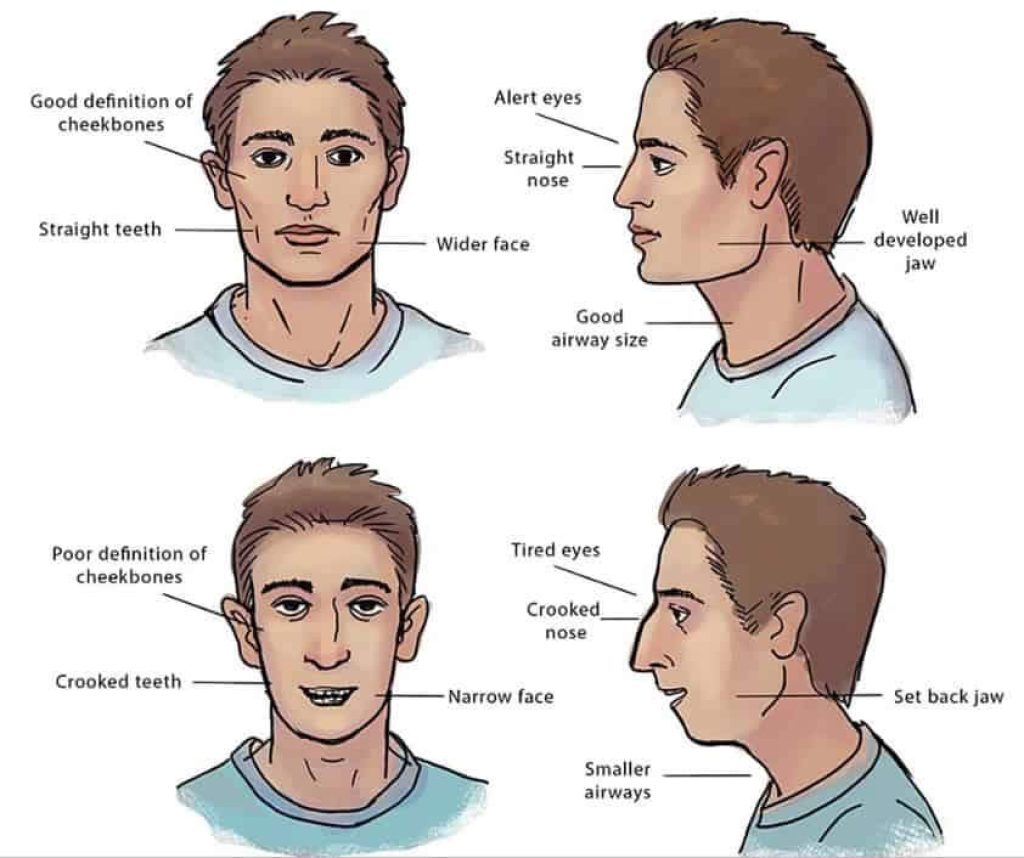
A palate that is too narrow reduces the space available for the tongue to rest against the roof of the mouth. The tongue often falls back and down, which contributes to mouth breathing during the day and airway restriction at night.
This is the chain that IOTN does not measure. The score evaluates how the teeth look and bite; it does not look at whether the patient is breathing through their mouth or sleeping badly. That gap is the reason many real cases of structural need are not captured by the funded pathway.
The outdated approach, and why it often makes things worse.
When expansion is not funded or offered, the common alternative is extraction-based orthodontics: remove premolars to relieve crowding, retract the front teeth into the gap. It is fast, predictable, and remains the default in many practices.
It also reduces the perimeter of the upper arch and can take space away from the tongue. We are not suggesting every extraction is the wrong call. We are saying the airway should be considered before the decision is made, and that often does not happen on the standard pathway.
What a structural assessment actually looks at.
A proper structural assessment for jaw and airway goes beyond IOTN. We map the suture and airway with CBCT imaging, examine tongue posture and breathing pattern, check the jaw joint, and review any prior orthodontic work. Jawthodontics™ is the category this fits into; WideSmiles™ is the slow-expansion method we use inside it.
The fee is £350, and it is fully redeemable against treatment if you decide to proceed. The assessment exists to give you an honest answer, not to commit you to anything.

Who is a candidate for palate expansion as an adult?
Adults with partially or fully fused sutures may still be candidates, depending on bone quality, airway picture and goals. MARPE is the most common non-surgical option. Surgical assistance is reserved for the small number of cases where it is genuinely required.
Some readers will not be candidates. We will say so plainly if that is what the imaging shows. There is no benefit to expanding a jaw that does not need it.
What the private pathway looks like in practice.
For adults whose NHS route is effectively closed, the private pathway begins with a structural assessment. At our clinic that is the £350 Jaw & Airway Analysis: sixty minutes including CBCT imaging, an airway and tongue-posture review, and a written treatment plan if appropriate.
The assessment is bounded and honest. If it shows you are not a candidate for expansion, we will say so plainly. If it shows you are, you will receive the full treatment fee in writing before any further commitment. The analysis fee is redeemable against treatment if you proceed.
What to ask your NHS dentist or orthodontist first.
Before considering private treatment, it is reasonable to extract as much value as possible from the NHS conversation you have access to. A few questions, asked clearly, often clarify whether NHS expansion is realistic for your case.
Ask your NHS dentist for a referral to NHS orthodontic assessment if you have not had one. Ask the orthodontist for your IOTN score and what it means in practice for your case. Ask whether expansion is considered part of your treatment plan if you proceed under the NHS, or whether the recommended treatment is alignment-only. Ask about waiting times in your specific region, not generally.
The answers may confirm that the NHS pathway will work for you. They may equally confirm that it will not, in which case you have a clear basis for evaluating private options. Either way you are better-informed for the next conversation. The £25 pre-consultation is a sensible next step if the NHS answer is unclear or unfavourable.
What to do if the NHS has said no, or you are not sure where to start.
A no from the NHS is not the same as a no from biology. The fastest sensible next step is the £25 pre-consultation, a short virtual call that lets us look at what you have noticed and tell you honestly whether the full assessment is worth booking. It is not a sales call.
Frequently asked
Can you get a palate expander on the NHS?
In children under 18, palate expansion may be available on the NHS if the case meets the IOTN threshold, typically grade 4 or 5. In adults, NHS funding for palate expansion is very rarely available and is generally limited to cases involving significant skeletal discrepancy assessed by a specialist. Most people seeking palate expansion will need to explore private options.
At what age does the NHS offer palate expanders?
NHS orthodontic treatment, including palate expanders, is generally available to children and young people under 18 in England, subject to IOTN scoring. The mid-palatal suture often begins to fuse in mid-to-late adolescence, which can affect the type of expansion that is appropriate. Earlier assessment may offer more options.
What IOTN score is needed for NHS orthodontic treatment?
The NHS generally funds orthodontic treatment for cases scoring IOTN grade 4 or 5, which indicates significant or very severe need. Lower grades are considered less urgent and are typically not funded. A narrow palate alone may not score highly enough unless it is accompanied by significant crowding or bite problems.
Can adults get palate expanders privately if the NHS says no?
Adults may be candidates for palate expansion privately, depending on suture status and the specific structural picture. Techniques such as MARPE can sometimes achieve expansion in adults where conventional expanders would not be effective. A structural assessment can clarify whether expansion is appropriate for your specific case.
Does a narrow palate affect breathing and sleep?
A narrow palate can reduce the space available for the tongue to rest in the correct position, which may contribute to mouth breathing, snoring, or disrupted sleep in some people. This functional dimension is often not captured by standard orthodontic scoring. An airway-focused assessment looks at the jaw and breathing together rather than teeth in isolation.
How do I get referred for a palate expander on the NHS?
In most cases, a referral to an NHS orthodontist can come from a general NHS dentist. The orthodontist will then assess your IOTN score to determine eligibility. Waiting lists vary significantly by region, and not all cases that warrant treatment will meet the funding threshold.
What is the difference between a palate expander and MARPE?
A conventional palate expander is a fixed appliance typically used in children while the mid-palatal suture is still open, allowing the two halves of the palate to be gradually separated. MARPE uses small titanium miniscrews anchored in the palate to apply force directly to the bone, and may be effective in older teenagers and some adults where the suture has partially fused.